Los Angeles · Pond & Water Feature Services
Pond Building
Custom ponds dug, lined, plumbed, planted and started up, from a small garden pond to a quarter-acre of open water.
Pond Building · Los Angeles
What Pond Building Actually Involves
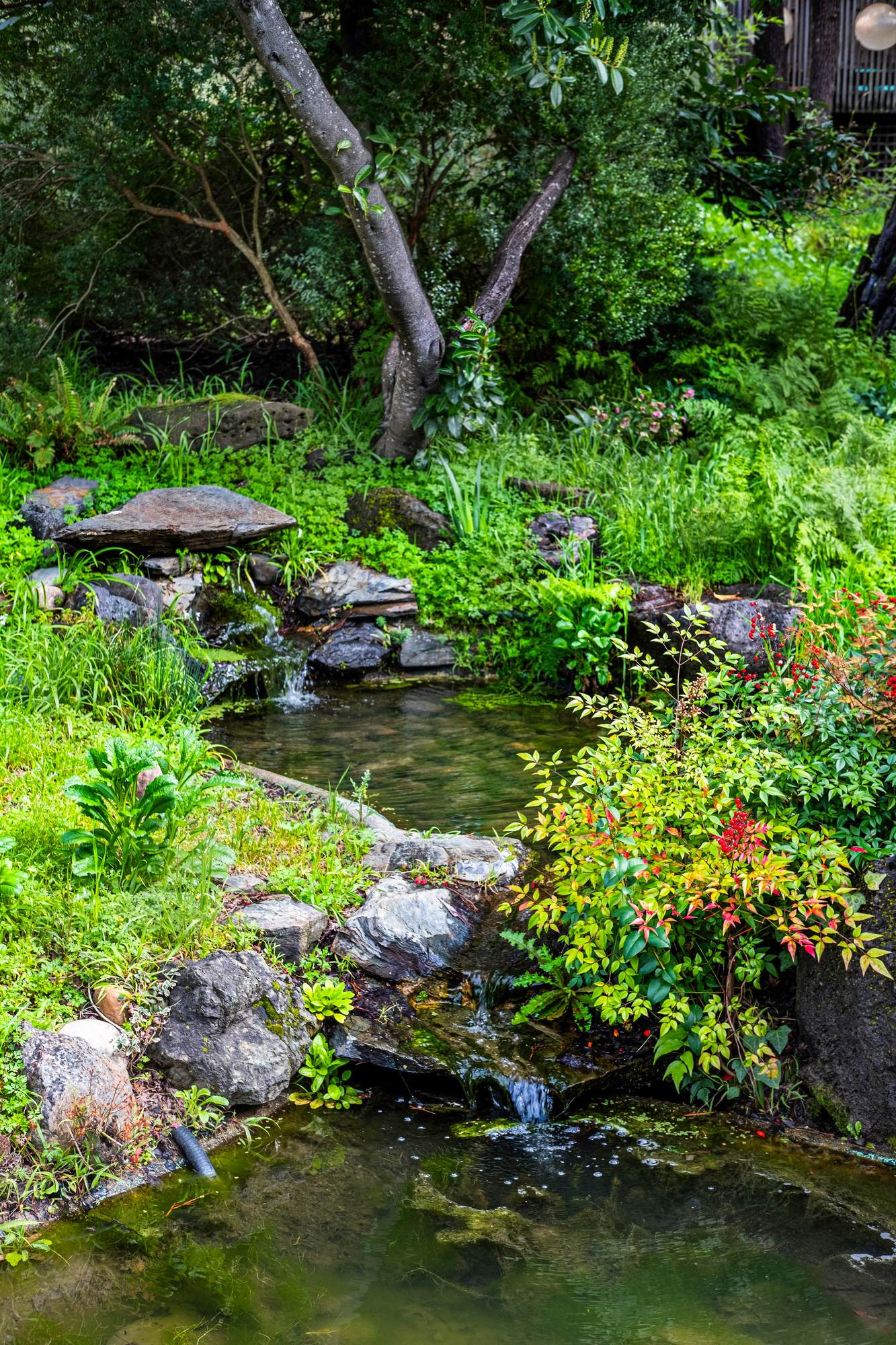
Pond building is the whole job: a design drawn to your yard, the excavation, the liner and underlayment, the plumbing, the filtration, the rockwork, the planting and the startup that gets the biology running. Most of what decides whether a pond stays clear happens underground, before anybody sees water. The shelves have to be cut at the right depths for the plants you want, the bottom has to fall toward the drain, the skimmer has to sit where the prevailing wind pushes the leaves, and the liner has to be seamed and protected so a raccoon or a settling boulder never finds it. We handle pond design, pond excavation, liner and plumbing, filtration sizing, boulder setting and aquatic planting as one contract with one crew, which is the only way the parts end up matching. A back yard pond in Los Angeles runs anywhere from a 6ft by 8ft garden pond behind a Silver Lake bungalow to a half-acre farm pond on a Hidden Hills horse property, and the method is the same at both ends. If you want moving water without a body of water to maintain, a pondless waterfall is the same construction with the reservoir buried under gravel instead.
Why Go With Us As Your Pond Builder
Anybody with a mini excavator can dig a hole and drop a liner in it. The difference between a pond company and a landscaper who has done a few shows up in year two, when the water either stays clear on its own or needs chemicals every fortnight to look acceptable. We size filtration to the real water volume and the real fish load rather than to the pump that was on the shelf, we build the plumbing so every part of it can be serviced without draining the pond, and we set boulders on compacted shelves so nothing shifts into the liner when the ground moves. We also finish the job: a pond handed over green with a bag of chemicals and a shrug is not finished, so we run the startup, seed the bacteria, get the water clear and come back to check it. We work across Los Angeles County from a shop on Venice Boulevard, and we would rather talk somebody out of a pond in the wrong spot than build it and hear about it every August.
- Licensed California landscape contractor, insured and bonded, with the permit pulled before the excavator arrives.
- Design drawn to your yard first, with depths, shelves, pump run and skimmer placement settled on paper.
- 45-mil EPDM liner over protective underlayment, seamed properly, never a preformed shell that cracks in five summers.
- Filtration sized to water volume and fish load, with mechanical, biological and UV stages that can be serviced without a drain-down.
- Boulders set on compacted shelves so a settling rock never finds the liner.
- Startup and biology run by us, then the same crew back for pond maintenance if you want it.
Reasons To Build A Pond
The yards that end up with water in them usually have at least one of these going on:
The yard is loud
Half of Los Angeles lives within earshot of a freeway, a boulevard or a flight path. Moving water does not cancel traffic noise, it masks it, because the ear stops tracking a broadband sound at close range. A pond with a modest waterfall on a Mid-City or Sherman Oaks lot changes what the back garden sounds like more than a fence ever will.
You want fish
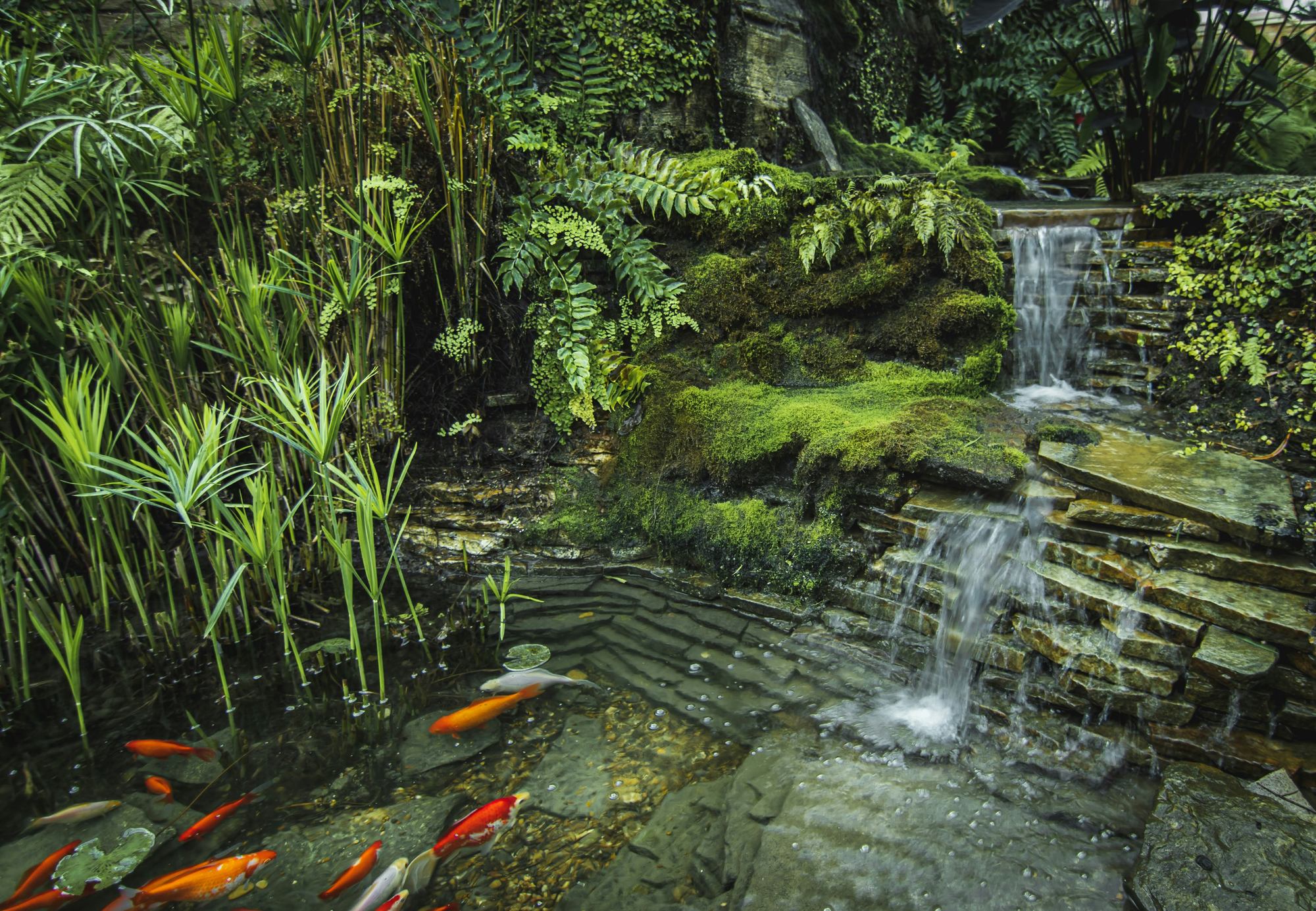
Koi and goldfish are the reason a lot of these builds start, and they set the specification. Fish need depth, turnover, aeration and real biological filtration, and a pond built without them in mind cannot be retrofitted cheaply. If fish are the point, say so at the design stage and we build a koi pond from the ground up.
There is a slope you cannot use
Hillside lots in Los Feliz, Encino, La Cañada and the Palisades are full of banks too steep to plant and too visible to ignore. A stream falling down that grade into a pond at the bottom turns the least useful part of the property into the part everybody looks at.
The lawn has to go
A pond uses far less water than the turf it replaces. An unshaded pond in Los Angeles loses roughly an inch to an inch and a half a week to evaporation in high summer, which over the same square footage is a fraction of what a fescue lawn drinks, and it stays green in August without a drop of overseeding.
The property is a venue
Event lawns, wedding gardens, restaurant patios and hotel courtyards use water as the thing photographs are taken in front of. Commercial builds get the same construction with heavier equipment, a service contract and, where the public can reach the water, a barrier that satisfies the city.
You want wildlife back
Open water brings dragonflies, hummingbirds, finches and lizards into a yard within weeks. On the larger parcels out toward Hidden Hills and Chatsworth the same build works as a duck pond or a stock pond, with a shallow beach entry instead of a coping edge.
Tell us the yard, the budget and whether there are fish in the plan, and we will tell you what fits and what it costs, usually within a couple of days. Call: (818) 293-2214
How A Pond Build Works
Five stages, one crew, and a pond that is running clear before we hand it over.
1. Design walk and concept
We walk the yard, find the low point, check the drainage and the sun, look at where the power is and where you actually sit. You get a layout with depths, shelves, waterfall grade, equipment placement and a flat-rate price rather than an allowance and a hope.
2. Permit and utility locate
Anything holding more than eighteen inches of water is a permit conversation with LA Building and Safety, and on hillside lots the grading ordinance applies too. We file it. We also mark utilities before the excavator moves, which matters more in the older parts of the city than anybody expects.
3. Excavation and shaping
Dig, shape the shelves, set the falls, compact the base. Spoil goes off site or gets built into the berm behind the waterfall, which is usually the cheaper and better-looking answer. Clay gets handled differently from decomposed granite, and we know which one your street sits on before we quote.
4. Liner, plumbing and rockwork
Underlayment, 45-mil EPDM, skimmer and bottom drain set, returns run, pump and filtration plumbed with unions so every part can come out. Then the boulders and gravel go in, set on compacted ground and pointed so the edge never reads as a black rubber rim.
5. Fill, planting and startup
Fill, dechlorinate, plant the margins and shelves, seed the beneficial bacteria and run it. We come back inside the first month while the biology settles, and again at the end of the first season, because a pond behaves differently once the plants have taken hold.
Pond Types, Liners, Depths And The Things That Move The Price
The decisions that make up a pond quote, and what each one changes:
Pond design
Design is where the money is saved. Shape follows the way you use the yard and the way water actually behaves: the deep end away from the seating, the skimmer downwind, the falls facing the house so the sound carries the right way, and the edge treatment chosen before the dig rather than after. We draw it, price it and change it on paper, which costs nothing compared to changing it in the ground.
Pond excavation
Most Los Angeles back yards are reached through a side gate, so the machine is a mini excavator or, on tight lots in Santa Monica and Manhattan Beach, a wheelbarrow and a crew. Access decides the price of the dig more than the volume does. Spoil disposal is a real line item in the city and a non-issue on the bigger Valley and Calabasas parcels where it can stay on site.
Backyard pond
The common Los Angeles build is somewhere between 8ft by 11ft and 15ft by 20ft, two to three feet deep, with a skimmer, a biofalls, a stream and a plant shelf around most of the perimeter. That size sits comfortably in a standard lot, supports goldfish and a few small koi, and does not turn the whole garden into a construction site.
Garden pond and water garden
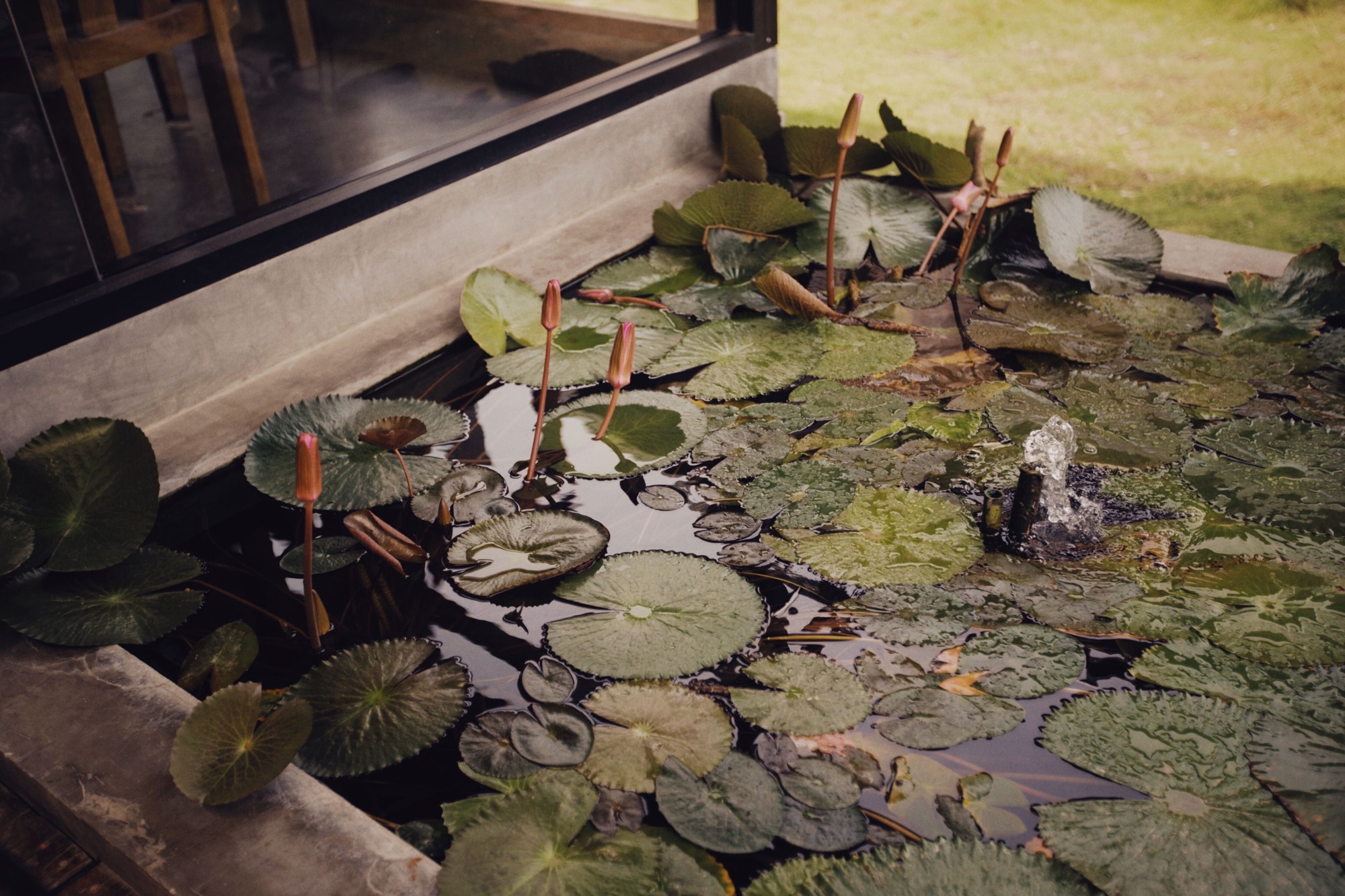
A water garden is a pond built around the plants instead of the fish. Lilies, lotus, iris, pickerel rush and marginal grasses across shelves at six, twelve and eighteen inches, a lighter fish load and less filtration. They are the cheapest ponds to build and the most seasonal to look at, and in a shaded Pasadena or Hancock Park garden they look like they have always been there.
Natural pond and farm pond
On acreage, a natural pond is shaped like a piece of ground rather than a feature: gentle banks, a beach entry, native sedges and rushes, and either a liner or a compacted clay bottom depending on the soil. Farm ponds and duck ponds out toward Hidden Hills, Chatsworth and Sunland get the same treatment with a heavier bottom and stock-safe edges.
Liner: EPDM, concrete or preformed
45-mil EPDM rubber over an 8oz geotextile underlayment is what we use for almost everything. It flexes with ground movement, takes any shape, is repairable in place and lasts decades. Concrete and shotcrete suit formal pools, raised walls and commercial work but crack on expansive soil unless engineered and sealed. Preformed plastic shells are cheap, small, awkward to edge and, in this climate, brittle inside a decade.
Depth and shelves
Twenty-four to thirty inches is enough for a plant-led pond. Fish want three feet, koi want four to five. Shelves at eight and eighteen inches carry the marginal planting, and a steep drop between them keeps a heron from wading in. Anything past eighteen inches deep is a barrier and permit question in Los Angeles, so depth is a code decision as much as a design one.
Filtration and circulation
Mechanical first, biological second, ultraviolet last if the pond gets full sun. The whole volume should turn over once an hour, twice for a heavy koi load. Skimmer at the surface, bottom drain at the low point, biofalls at the head of the stream, everything on unions. Get this wrong and the pond is green every June no matter how it looks in the photos.
What Pond Building Costs In Los Angeles
A small garden pond starts around $5,000. Most Los Angeles back yard builds land between $12,000 and $35,000. Large koi systems, swim ponds and estate work run from $50,000 past $100,000. What moves the number:
- Size and depth. Volume drives the liner, the pump, the filter and the dig, and it compounds: doubling the surface area more than doubles the price once the depth goes with it.
- Access. A yard the excavator can reach costs a fraction of one where every yard of spoil leaves through the house or over a wall. This is the single biggest swing on tight westside lots.
- Soil. Decomposed granite in the hills digs fast. Clay in the Valley flats holds water and needs drainage behind the liner. Rock and old fill both slow a dig down and both turn up in this city.
- Rockwork. Boulders are priced by weight and set by machine, and the stone is what makes a pond look built rather than installed. It is also the easiest place to spend or save real money.
- Filtration and fish load. A plant pond needs a fraction of what a koi pond needs. Bottom drains, settlement chambers and a serious biofilter are a koi decision, and they are much cheaper to build in than to add.
- Waterfall height and length. Every foot of lift is pump energy forever, and every foot of stream is more liner, more stone and more labor.
- Permits, barriers and hillside grading. Eighteen inches of water triggers the barrier rules, and a slope triggers the grading ordinance. Both are quoted, not buried.
Every quote is flat-rate and covers the design, the dig, the liner, the plumbing, the filtration, the stone, the planting and the startup. If a full pond is more than the yard needs, the same crew builds smaller water features and fountains, and you can see the full range of pond and water feature work we do across Los Angeles in one place.
Frequently Asked Questions
How much does it cost to build a pond?
A small garden pond of around 6ft by 8ft with a pump, a skimmer and simple planting starts near $5,000. The common Los Angeles back yard build, roughly 11ft by 16ft with a stream, a waterfall and full filtration, runs $12,000 to $35,000. Koi systems with bottom drains and settlement chambers, natural swimming ponds and estate-scale water go from $50,000 to well past $100,000. The largest swings are access, depth and rockwork rather than surface area alone, which is why two ponds the same size on two streets can be priced very differently.
How long does a pond take to build?
A simple pondless feature can be in and running in two days. A typical back yard pond with a stream and a waterfall takes one to two weeks on site. Large koi systems, swim ponds and anything with structural walls or hillside grading run three to six weeks. Add time in front of that for design and permitting, which in the City of Los Angeles is usually two to four weeks depending on whether a barrier or grading review is involved. The water goes in near the end, and the biology needs another four to six weeks after that to fully settle.
Do I need a permit to build a pond in Los Angeles?
Usually, yes. California treats any body of water deeper than eighteen inches as a pool for safety purposes, so a pond past that depth brings barrier requirements and a permit through LA Building and Safety. Electrical for the pump needs its own permit and a GFCI circuit. On a slope, the hillside grading ordinance applies to the excavation, and in some hillside areas an engineered plan is required. Shallow water gardens under eighteen inches, disappearing fountains and pondless waterfalls usually avoid all of it, which is one honest reason to consider them. We file whatever the job needs and hand you the signed card at the end.
Where is the best place to put a pond?
Somewhere you can see it from the house, mostly out of the hottest afternoon sun, away from the drip line of a big deciduous tree, and never in the low point where the yard already drains. Four to six hours of sun a day suits lilies without cooking the water; full all-day sun in the Valley pushes algae and evaporation hard. Keep it clear of tree roots that will lift a shelf, clear of the septic field on the rural parcels, and close enough to power for a proper GFCI circuit. We walk this before drawing anything, because moving a pond on paper is free.
What kind of pond can I build in clay soil?
Any of them, with two adjustments. Clay holds water behind the liner, so the excavation gets a drainage layer and a sump where the water table or the irrigation runoff can push a liner up from below. Clay is also expansive, which is why we use EPDM rather than rigid concrete on most Valley and Baldwin Hills sites. Well-compacted clay can even serve as the bottom of a large farm pond without a liner, though almost every urban build in Los Angeles is lined regardless because seepage into a neighbor is not a risk worth taking.
What liner do you use and how long does it last?
45-mil EPDM rubber over 8oz geotextile underlayment, seamed with proper tape and primer where a single sheet will not cover. It stays flexible in cold and heat, tolerates ground movement, and is repairable in place with a patch rather than a rebuild. Manufacturers warrant it for twenty years and it routinely outlasts that. Concrete and shotcrete are options for formal or structural work and get waterproofing and a sealer. We do not install preformed plastic shells, which are limiting to edge properly and brittle in this climate.
Can you build a pond on a slope?
Yes, and slopes usually produce the better-looking result, because a stream and a waterfall have somewhere real to come from. The pond sits at the bottom on a cut-and-fill bench, the stream is built down the grade, and the pump line runs back up. What changes is the engineering: cut slopes need to be stable, fill needs to be compacted, and in the Los Angeles hillside areas the grading ordinance and sometimes a soils report apply. We quote hillside work with that included rather than discovering it at permit stage.
Does a pond increase property value?
A well-built, well-maintained water feature is generally treated by appraisers the way any quality hardscape is, and landscape industry surveys have long put good landscaping at roughly five to twelve percent of home value. In Los Angeles the effect is strongest where the yard is small and the noise is real, because a pond changes how the outdoor space is used rather than just how it looks. The qualifier matters: a neglected green pond with a cracked shell reads to a buyer as a liability, which is an argument for building it properly and keeping it on a service schedule.
Can you build a pond in a small yard?
Yes, and small ponds are a large part of what we do in Silver Lake, Venice, Santa Monica and the older parts of Mid-City where the lots are narrow. A 6ft by 8ft pond with a short stream fits a side yard or a courtyard and still reads as real water. Below that size the water heats and swings too fast for fish, so we usually steer very tight spaces toward a pondless waterfall or a self-contained fountain, which give the sound and the movement with no open water to balance.
Planning a pond in Los Angeles?
Tell us what the yard looks like and what you are imagining, and we will come back with a free estimate and a flat-rate price.
Or call us now: (818) 293-2214