Los Angeles · Pond & Water Feature Services
Swimming Ponds
Natural swimming ponds with a clean swim zone and a planted regeneration zone doing the filtering. No chlorine, no salt, no red eyes.
Swimming Ponds · Los Angeles
How A Natural Swimming Pond Works
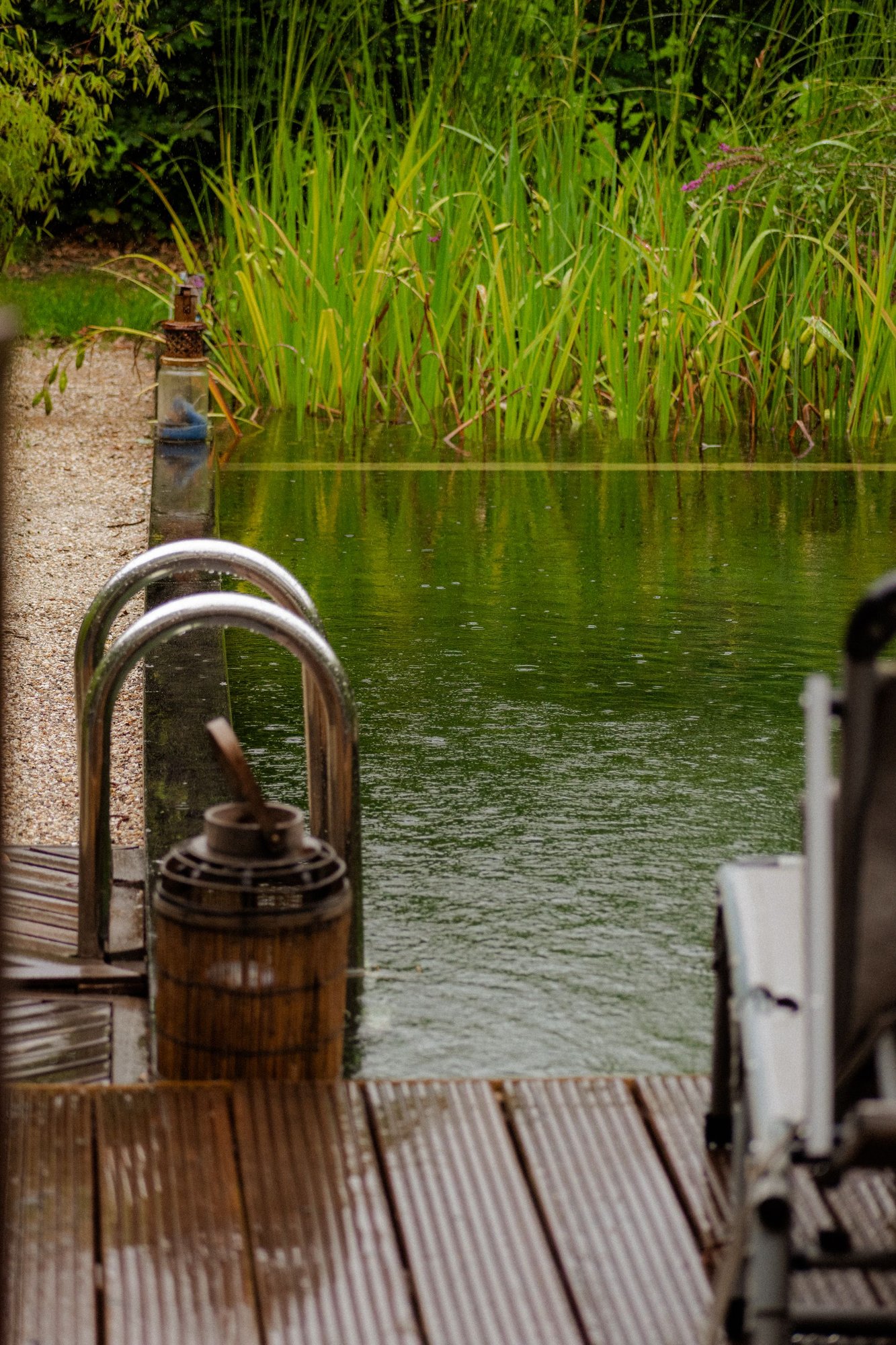
A natural swimming pond is two connected bodies of water pretending to be one. The swim zone is deep, clear and free of planting, with a proper floor and an edge you can get in and out of. Alongside or beneath it sits the regeneration zone, a shallow gravel bed planted with reeds, rushes and iris, and the pump moves water slowly between the two. Bacteria living on the gravel and the plant roots strip nitrogen and phosphorus out of the water, which starves algae of what it needs to bloom, and the result is water that stays clear without chlorine, salt or a chemical routine. What you swim in is closer to a spring-fed lake than a pool: cooler in the shade, alive at the edges, and completely fine on skin, eyes and hair. In exchange the surface area has to be bigger than a pool of the same swim area, because the regeneration zone typically runs from a third to half the total. Chemically treated pools are quicker to build and smaller; the trade is a lifetime of chlorine and a body of water nothing else wants to live near.
Why Go With Us For A Swim Pond
Natural swimming ponds are a specialist build and there are not many crews in Southern California who do them properly. The failure mode is predictable: somebody builds a big pond, calls the shallow end a regeneration zone, undersizes it, and hands over water that goes green every July. The regeneration zone has to be big enough, the gravel has to be the right grade and depth, the flow has to be slow and even across the whole bed rather than short-circuiting through one corner, and the swim zone has to be separated so that swimmers do not stir sediment into the water they are in. We design from the plant bed outward. We also build for this climate specifically, which means planning for the evaporation and the heat load of a Los Angeles summer, and for the water the pond needs when the temperature is in the nineties for a week.
- Regeneration zone sized as a proportion of the whole pond, not squeezed in once the swim area is decided.
- Graded gravel bed at the correct depth, with distribution that pushes water evenly through the bed rather than around it.
- Swim zone separated hydraulically, so swimming does not put sediment into the water you are in.
- Skimming and circulation planned around a Los Angeles summer, when evaporation and heat load both peak.
- 45-mil EPDM liner over underlayment, with the swim floor and entry built to be used barefoot.
- The same crew back for seasonal pond maintenance, which on a swim pond is mostly plant work.
Reasons To Build A Swimming Pond
People choose swim ponds over pools for a fairly consistent set of reasons:
Chlorine is a problem in the house
Sensitive skin, eczema, asthma and simple dislike of the smell account for most of the inquiries. There is nothing to react to in a natural pond: no chlorine, no bromine, no salt cell, and no bleached swimwear.
You want the yard to look like a landscape
A pool reads as a pool from every angle. A swim pond reads as water in a garden, and in the canyons and the hillside lots around Los Feliz, Encino and the Palisades that difference is the whole reason people build them.
You are already keeping a pool you do not use much
A chemically treated pool costs money every month whether anybody swims or not. A swim pond has a pump bill and a plant-maintenance rhythm, and it looks like something worth having in the months nobody is in it.
You want wildlife without a mosquito problem
Dragonflies, birds and frogs move in quickly. Mosquitoes do not, because the water moves and the regeneration zone supports the things that eat larvae. The Greater Los Angeles County Vector Control District supplies mosquitofish free to residents if extra insurance is wanted.
The site suits it
Bigger lots make this easier, which is why most of our swim pond work is out toward Calabasas, Hidden Hills, Tarzana and the larger Palisades and La Cañada properties. A regeneration zone needs real square footage and it is not a feature you can shrink your way into.
You want to convert an existing pool
A conventional pool can be converted, either by building the regeneration zone alongside it and plumbing the two together or by giving up part of the existing shell to planting. It is a genuine option and it is usually cheaper than starting over.
If you have the space and you want water you can swim in without treating, tell us the site and we will tell you honestly whether it works there. Call: (818) 293-2214
How A Swimming Pond Gets Built
The plant bed is designed first, because everything else has to fit around it.
1. Site assessment and zone sizing
How much swim area you want sets how much regeneration zone the pond needs, which sets the footprint. Sun, shade, prevailing wind, slope and where the water comes from all get worked out before a line is drawn. This is the stage where a site either works or does not.
2. Design, engineering and permit
A swim pond is a pool in the eyes of the code, so it comes with barrier requirements, an electrical permit and, in the Los Angeles hillside areas, grading review. Larger builds get structural detail for the swim zone walls. We handle the filing and the inspections.
3. Excavation and zone separation
Deep swim basin, shallow regeneration bench, and a separating wall or berm between them that keeps sediment and planting out of the swim area while letting water move freely underneath or over it. Getting this detail right is what makes the pond swimmable rather than just wet.
4. Liner, gravel bed and hydraulics
Underlayment and EPDM across both zones, then the distribution pipework laid into the regeneration bed and covered with graded gravel to the right depth. Slow, even flow through the whole bed is the design target; a bed the water races past in one channel does nothing.
5. Planting, fill and establishment
The bed is planted with rush, iris, sedge and other emergent species, filled and dechlorinated, then given a season to establish. Clarity improves as the roots and biofilm develop, and a first-summer swim pond looks different from a second-summer one. We stay on it through that first year.
Zones, Water, Depth And Living With A Swim Pond
What people ask about most before committing to one:
The regeneration zone
A shallow gravel bed, typically 12 to 18 inches deep, planted with emergent species and carrying the biological load of the whole pond. It usually occupies a third to half the total water area. Undersizing it is the single most common reason a natural pool fails, and it cannot be corrected afterwards without rebuilding.
The swim zone
Deep, unplanted and separated, with a floor you can stand on and an entry you can use barefoot. Four to six feet is typical for swimming, deeper if anybody intends to dive. The wall between the zones is usually just below the waterline, so from a chair the pond reads as one continuous surface.
Water clarity and temperature
A settled swim pond runs clear enough to see the floor, though never with the sterile blue of a chlorinated pool: expect a slightly green cast and a living edge. Water temperature tracks the weather, which in Los Angeles means comfortable swimming from late spring through October, and warmer than a pool in high summer because the shallow zone gains heat.
Chemical-free operation
No chlorine, no bromine, no salt. The biology handles pathogens and nutrient, and circulation and skimming handle the rest. Some owners add ultraviolet on the return as extra insurance, which is compatible with the system as long as it does not sit between the plants and the nutrient they need.
Converting an existing pool
Two approaches. Build a regeneration zone alongside the pool and plumb them together, which keeps the full swim area. Or give up the shallow end of the existing shell to gravel and planting, which is cheaper but costs swim space. Either way the existing shell, plumbing and equipment pad usually have real salvage value.
Maintenance
Less chemistry, more gardening. Skim the surface, keep the pump and skimmer clear, cut back and thin the plants once or twice a year, and remove settled debris from the swim zone floor. There is no chlorine to test or balance and no salt cell to replace. Most owners find the total time about the same as a pool and considerably more pleasant.
Water use and evaporation
A swim pond loses water to evaporation like any open surface, roughly an inch to an inch and a half a week in a Los Angeles summer, and its larger total surface means more than a pool of the same swim area. There is no backwashing and no draining, though, so annual consumption is comparable and the water is not being dumped chlorinated.
Safety and code
California treats any water over eighteen inches deep as requiring a barrier, and a swim pond is unambiguously in that territory. Fencing, self-closing gates or an approved alternative apply exactly as they would for a pool, and the electrical for the pump needs a permit and a GFCI circuit. We build it to be signed off, not to be argued about later.
What A Swimming Pond Costs In Los Angeles
Most natural swimming ponds run $80,000 to $200,000 built, and small ones can come in under that. Converting an existing pool is usually $40,000 to $90,000. What moves it:
- Total footprint. The regeneration zone is a third to half the water area, so the excavation and liner are always larger than the swim area suggests.
- Swim zone depth and structure. A deep basin with retained walls is a structural job, and on a hillside it needs engineering.
- The gravel bed. Graded gravel at the right depth across a large bench is a significant material and labor cost, and it is not the place to economize.
- Access and spoil. Swim ponds move a lot of dirt. Whether a machine and a truck can get to the site is the largest single price variable.
- Edging, decking and entry. Coping, a beach entry, steps, a dock or a stone terrace all sit on top of the pond cost.
- Planting. The regeneration zone needs to be planted densely from the start to establish quickly, which is a real plant budget.
- Barrier and permits. Fencing or an approved alternative, plus the electrical and grading permits, are part of the job here.
We quote the whole thing flat-rate, including the establishment visits through the first season, because a swim pond is not finished on the day it fills. If the space will not carry a regeneration zone, a koi pond or an ornamental pond build gets water into the yard for a lot less, and the full range of ponds and water features we build in Los Angeles is on one page.
Frequently Asked Questions
What is a natural swimming pond?
It is a swimming body of water kept clean by biology instead of chemistry. A deep, unplanted swim zone is paired with a shallow gravel bed planted with reeds, rushes and iris, and a pump moves water slowly between them. Bacteria on the gravel and plant roots take up the nitrogen and phosphorus that algae would otherwise use, so the water stays clear without chlorine, bromine or salt. From a chair it reads as one pond, because the wall between the zones sits just below the surface. What you swim in is much closer to a clean lake than to a pool.
Is the water safe and clean to swim in?
Yes, in a properly built and established pond. The regeneration zone removes the nutrient that would otherwise feed algae and bacteria, and continuous circulation and skimming handle the rest. Natural swimming pools have been standard across Europe for decades with a good public-health record, including at municipal scale. The water will not look like a chlorinated pool: expect a faint green cast, a living edge and a floor you can see rather than a tiled blue. If you want extra reassurance, an ultraviolet unit on the return is compatible with the system.
Do swimming ponds get algae?
Some algae on rocks and on the gravel bed is normal and healthy, and it is part of what is doing the filtering. Green water is not, and it means the regeneration zone is undersized, the flow is short-circuiting through part of the bed instead of the whole of it, or the plants have not established yet. New ponds are cloudier in their first summer and improve markedly in the second as the roots and biofilm develop. Persistent green water in an established pond is a design problem rather than a treatment problem, which is why the bed sizing is the part we will not compromise on.
Can I convert my pool into a natural swimming pond?
Often, yes, and it is a good use of an existing shell. The two routes are to build a regeneration zone alongside the pool and plumb the two together, keeping the full swim area, or to convert the shallow end of the existing shell into gravel and planting, which is cheaper and costs swim space. The existing structure, plumbing and equipment pad usually carry real value into the conversion. Conversions in Los Angeles typically run $40,000 to $90,000 depending on which route and how much of the existing hardware is reusable.
Do swimming ponds breed mosquitoes?
No, when they are running. Mosquitoes need still water for several days to complete a life cycle, and a swim pond circulates continuously with a skimmed surface. The regeneration zone also supports dragonfly larvae, damselflies and other predators that eat mosquito larvae, and fish can be added to the plant zone if you want more insurance. The Greater Los Angeles County Vector Control District provides mosquitofish to residents at no charge. The one real risk is a pond left with the pump off for a week in summer, which is true of any body of water.
How much space do I need?
Enough for the swim area you want plus a regeneration zone of a third to half the total water surface. In practice a usable swim pond starts around 800 to 1,000 square feet of total water, which needs a yard that can carry it plus the surround. This is why most of our swim pond work is on the larger lots out toward Calabasas, Hidden Hills, Tarzana, La Cañada and the bigger Palisades properties rather than on a standard city lot. If the space will not take a proper plant bed, we will say so rather than build something that goes green.
How warm does the water get?
It tracks the weather, with no heater involved. In Los Angeles that means comfortable swimming from late spring through October in most years, and genuinely warm water in high summer because the shallow regeneration zone gains heat and feeds it back. It also means the pond is cold in January, unlike a heated pool. Some owners add solar heating to the swim zone, which works, though pushing water temperature much past the mid-eighties starts to affect the biology and is not something we encourage.
What maintenance does a swim pond need?
The work is gardening rather than chemistry. Skim the surface and keep the skimmer and pump clear, cut back and thin the regeneration planting once or twice a year, remove settled debris from the swim zone floor, top up for evaporation and check the flow distribution across the bed. There is nothing to test, no chlorine to dose, no salt cell to replace and no backwashing. Most owners find the hours comparable to a pool. We run seasonal visits for owners who would rather not do the plant work themselves.
Planning a pond in Los Angeles?
Tell us what the yard looks like and what you are imagining, and we will come back with a free estimate and a flat-rate price.
Or call us now: (818) 293-2214