Los Angeles · Pond & Water Feature Services
Water Features
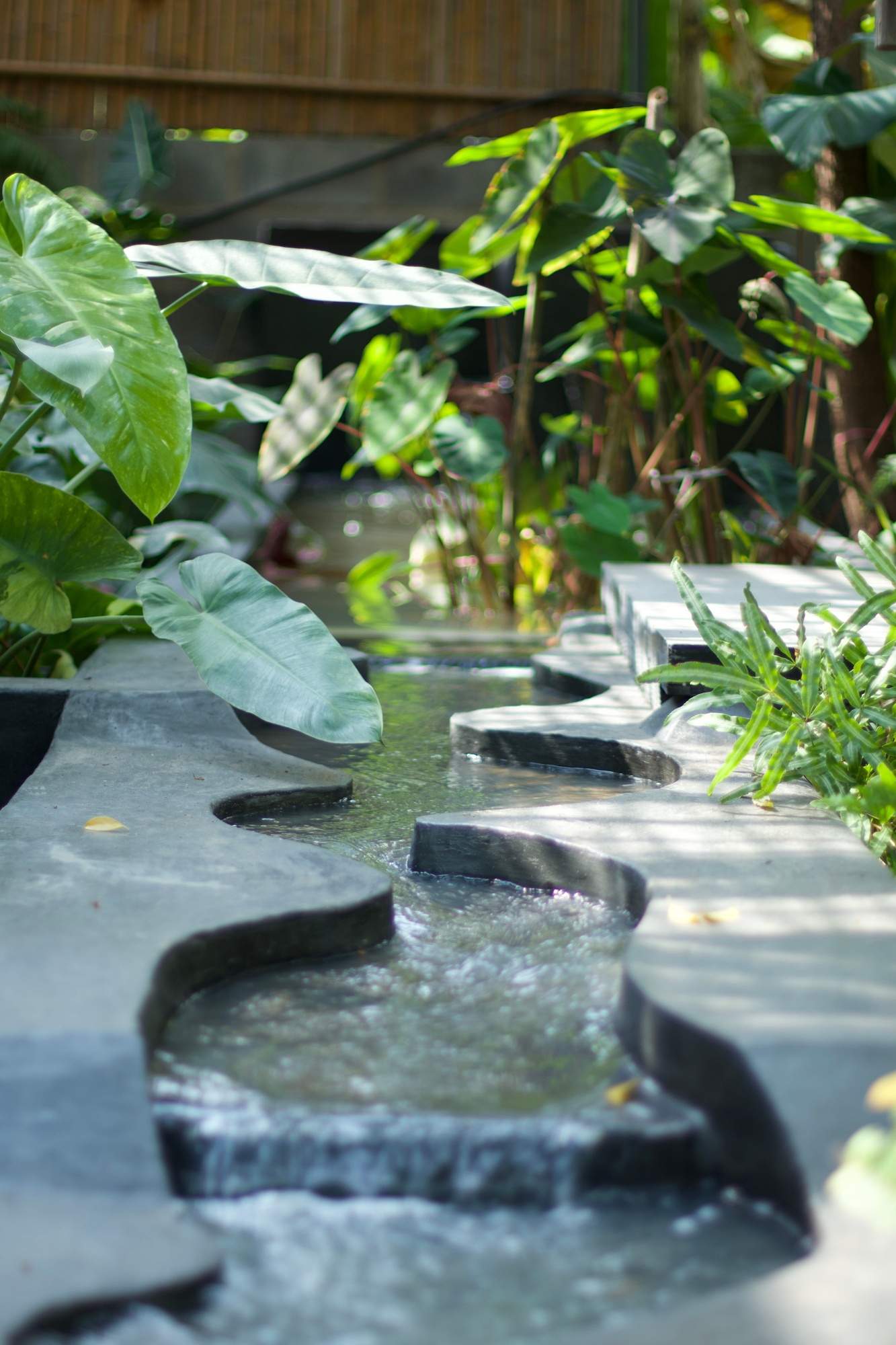
Streams, rills, spillway bowls, basalt columns, urns and wall spouts, built and plumbed as part of the landscape.
Water Features · Los Angeles
What Counts As A Water Feature
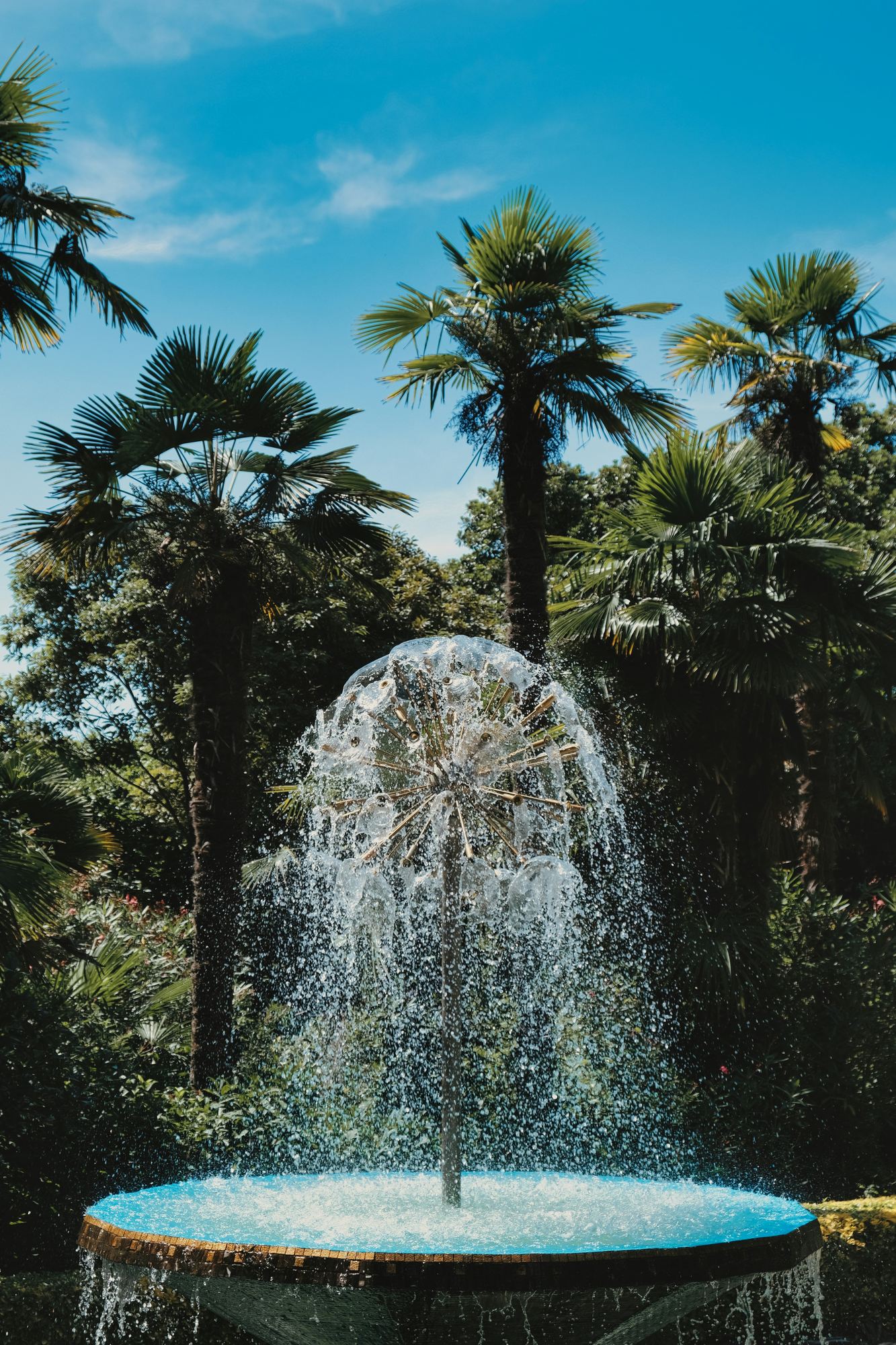
Water feature is the catch-all for everything that moves water in a garden without being a pond you have to keep fish in. A stream running down a slope with a hidden reservoir at the bottom. A rill cut into a terrace with stepping stones across it. A run of basalt columns bubbling into a gravel bed. A spillway bowl over a raised wall. A ceramic urn with water welling over the rim and disappearing into a basin below. A wall spout into a trough beside a courtyard seat. All of them work the same way underneath: a hidden basin, a pump, a return line and a fill point, so the visible water is a thin film over a reservoir nobody sees. That construction makes them the practical answer for most Los Angeles yards. There is no open standing water, so the eighteen-inch depth rule that brings permits and fencing does not apply, there is nothing for a child or a dog to fall into, the water use is small, and the maintenance is a pump and a basin rather than an ecosystem. If you want fish, plants and the whole living system, that is a pond build instead.
Why Have Us Install It
Outdoor water features are sold at every garden center in the county, and most of the ones we get called to fix were installed by somebody who set the visible object down and buried the rest. Undersized basins that run dry in a week. Pumps with no isolation, so servicing means dismantling the stone. Autofill valves that were never fitted, so somebody has to remember a hose every few days. Splash that lands on a wall and stains it, or on a path and freezes nobody but soaks everyone. We build the invisible half properly: a reservoir sized for real evaporation and splash, a service hatch you can actually get a pump out of, a dedicated GFCI circuit run by an electrician rather than a cord across a patio, and an autofill so the thing keeps running while you are away. We also match the feature to the spot, which mostly means being honest about how much sound a given amount of water and fall actually makes.
- Reservoirs sized for evaporation and splash in a Los Angeles summer, not for the box the kit came in.
- Service access designed in, so a pump swap does not mean lifting the stonework.
- Autofill valve and a dedicated GFCI circuit installed properly, not an extension lead under a mat.
- Splash mapped before the build, so nothing stains a wall or soaks a walkway.
- Stone, basalt, ceramic and cast options sourced to match the architecture rather than whatever is in stock.
- No permit or barrier needed on most features, because there is no standing water to trigger it.
Reasons To Install A Water Feature
Water features get built where a pond will not fit or is not wanted:
You want the sound without the pond
Sound is the reason most of these get built. A small volume of water falling a foot or two into a hard basin produces a surprising amount of it, and in a Mid-City or Hollywood back garden that is enough to change how the space feels against traffic noise.
There are small children or dogs
A pondless feature has no open water. Nothing to fall into, nothing to fence, nothing to worry about with a toddler in the yard, and no barrier requirement from the city.
The space is tiny
A side yard in Venice, a courtyard off a Silver Lake bungalow, a balcony terrace in Brentwood. A single urn or a pair of basalt columns needs three or four square feet and turns dead space into somewhere worth walking past.
You are renting or might move
Self-contained features are far less permanent than a pond and some of them can genuinely be taken with you. It is a much lower commitment than excavating a yard.
The entry needs something
Front courtyards, entry paths and commercial frontages use water as an arrival point. A spillway bowl or a wall spout in an entry works hard for a small footprint and reads well at night with a single uplight.
You want to start small
Plenty of people build a feature first and a pond three years later. It is a reasonable way to find out whether you like living with the sound and the upkeep before committing to an excavation.
Send a photo of the spot and we will tell you what fits it, what it sounds like and what it costs. Call: (818) 293-2214
How An Installation Runs
Most features are one to three days on site from arrival to running water.
1. Selection and siting
We look at where you sit, where you walk past, what the feature will be seen against and where the power is. Then we pick the type and the size, and we are specific about how much noise it will make, because that is the expectation people most often get wrong.
2. Basin and plumbing
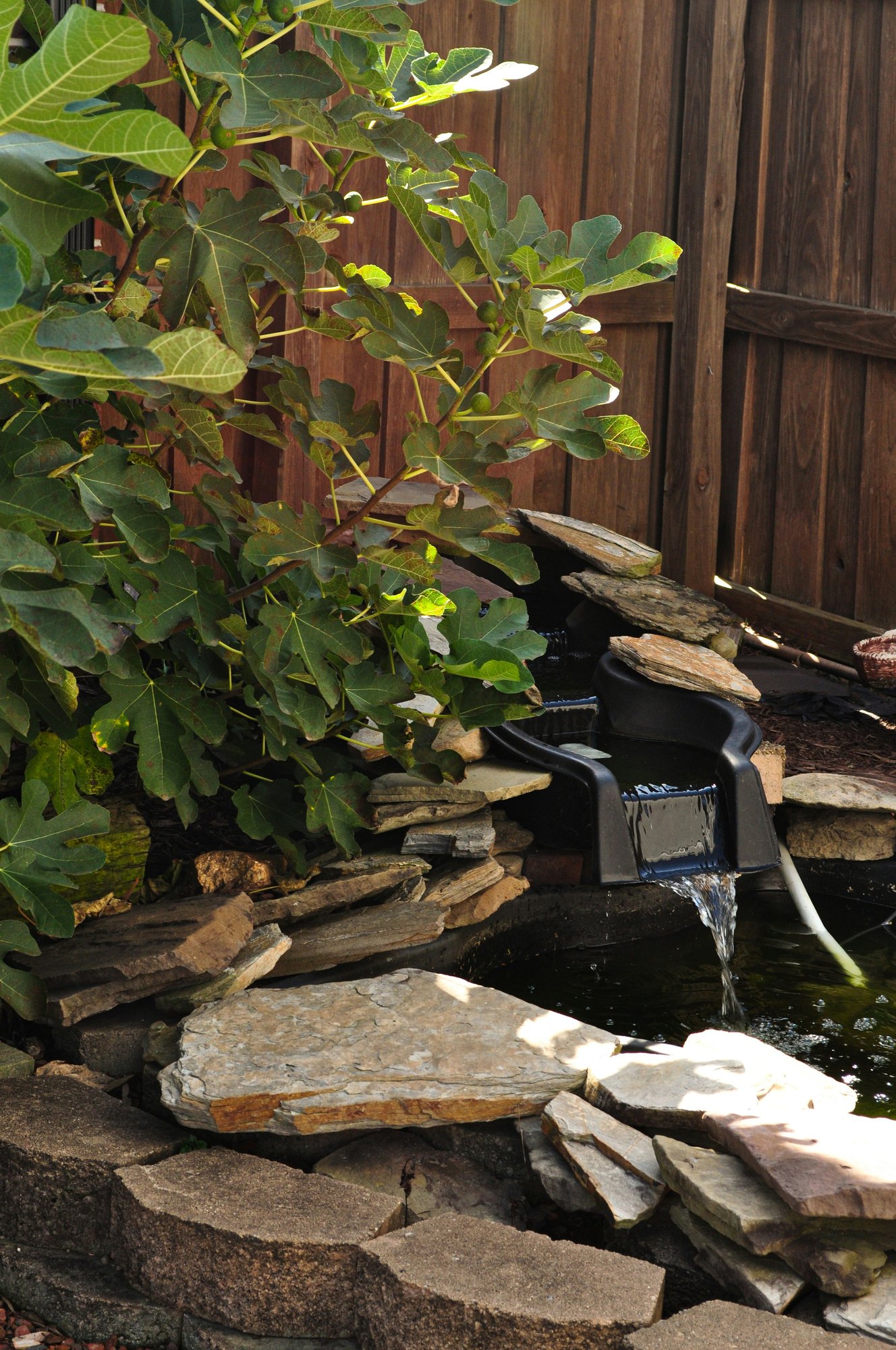
Excavate for the reservoir, set the basin or the matrix modules, run the return line, plumb the autofill and set the pump on an isolating union. This is the part that decides whether the feature is a pleasure or a chore for the next decade.
3. Electrical
A dedicated GFCI circuit run in conduit to a proper outdoor box by a licensed electrician. Low-voltage lighting goes in at the same time, because retrofitting a light into a set stone feature is not a small job.
4. Setting the feature
Column, bowl, urn or stone set level and shimmed, gravel and cobble over the basin, splash checked and adjusted with the pump running, flow valved to the sound you want.
5. Fill, test and handover
Fill, run it, watch it for splash and level loss, dial the flow in, then show you where the pump, the valve and the fill point are. Most people never need to touch it beyond topping up and rinsing the pump screen.
Streams, Columns, Bowls, Urns And Wall Spouts
The kinds of outdoor water feature we install most in this city:
Streams and rills
A stream is a length of lined, rock-set channel falling gently across a garden into a hidden reservoir. A rill is its formal cousin, a straight cut channel in stone or concrete, often with stepping stones. Both need a real grade to work, which makes them natural on the hillside lots and a design problem on flat ones.
Basalt and stone columns
Drilled basalt columns in a group of three, water welling over the top and running down the face into a gravel bed. They are contemporary, quiet, need almost no room and work on a modern house better than almost anything else. A group of graduated heights reads better than a single column.
Spillway bowls and scuppers
A bowl or a scupper set into a raised wall, spilling into a basin or a pond below. This is the sharp-edged, architectural end of water and it suits courtyards, entries and the raised planters that show up on so many Los Angeles remodels. Sound is controlled by the drop height and the lip detail.
Urns and vases
A glazed or cast urn with water welling over the rim into a hidden basin under gravel. The most self-contained feature there is, movable, and the easiest one to fit into a small courtyard or beside a doorway. Frost is a non-issue at this latitude, so the ceramic options stay open.
Wall fountains and spouts
A spout, mask or slot in a wall falling into a trough or basin. Ideal where there is no floor area to give up and a blank stucco wall to fix. Getting the plumbing chased into the wall properly is what separates a good one from a hose stapled behind a plant.
Pondless reservoirs
Underneath most of these sits a basin or a stack of structural matrix modules, covered with gravel and cobble. Sizing it correctly for evaporation, splash and pump submergence is the difference between a feature that runs for weeks unattended and one that needs a hose every second day.
Lighting
Low-voltage light placed under a spill or grazing across a column changes what the feature is worth after dark, which in Los Angeles is when people are actually outside. It is fitted during the build because retrofitting into set stone means taking the stone apart.
Commercial and entry features
Restaurant patios, hotel entries, office courtyards and multifamily frontages. Same construction, heavier duty pumps, tamper-resistant equipment access, and a maintenance schedule, because a stagnant feature at a business entrance is worse than no feature at all.
What A Water Feature Costs In Los Angeles
A self-contained urn or a single column installed runs about $2,500 to $6,000. A basalt group or a spillway bowl runs $5,000 to $15,000. A built stream with a hidden reservoir runs $12,000 to $40,000. What moves it:
- The feature itself. A cast urn and a hand-carved stone basin are an order of magnitude apart before anybody digs.
- Reservoir size. More water above ground means more reservoir below it, and the excavation and modules that go with it.
- Length and fall. A stream is priced by the foot: liner, stone, labor and the pump to lift it all back to the top.
- Electrical. A new GFCI circuit from the panel to a far corner of the yard is a real cost, and it is not somewhere to improvise.
- Stone and finish. Set boulders, cut coping and gravel over the basin are what make a feature look built into the garden rather than delivered to it.
- Access. Basalt columns and stone bowls are heavy, and getting one through a side gate versus craning it over a house is a very different day.
- Lighting and extras. Low-voltage lighting, an autofill valve and a variable-speed pump are each modest and each worth having.
Everything is quoted flat-rate including the basin, the plumbing, the electrical and the setting. If it is specifically a fall of water you are after, the waterfalls page covers that in depth, and formal fountains are their own thing. The whole Los Angeles pond and water feature range sits on one page.
Frequently Asked Questions
What is the difference between a water feature and a pond?
A pond is an open body of water with a biological system in it: depth, plants, usually fish, filtration and a balance to maintain. A water feature moves a small amount of water over a visible surface and hides the reservoir underground, so there is no standing water, no ecosystem and nothing to balance. That difference has practical consequences in Los Angeles. Features avoid the eighteen-inch depth rule that brings barrier and permit requirements, they are safe around small children and dogs, they use very little water, and their maintenance is a pump and a basin rather than water chemistry.
Do water features use a lot of water?
No. The water recirculates, so consumption is only what evaporates and what splashes out. A small urn or column feature loses a few gallons a week in summer and less the rest of the year. A long stream with a wide surface loses more, but it is still a fraction of what the equivalent area of lawn drinks. An autofill valve plumbed to the irrigation line handles top-ups automatically, which is worth fitting on anything you would rather not think about while you are away.
How much noise does a water feature make?
More than people expect from a small feature and less than they expect from a big one. Sound comes from the drop height and the surface the water lands on far more than from the volume: a thin sheet falling eighteen inches into a hard basin is louder than a large stream sliding over gravel. A single urn is a soft trickle at conversational distance. Basalt columns are quiet. A spillway bowl with a foot of drop is clearly audible across a patio. We valve the flow at commissioning so you can set it where you want, and it is worth listening to one running before choosing.
What maintenance does a water feature need?
Very little. Rinse the pump screen every month or two, keep leaves out of the basin, top up if there is no autofill, and once or twice a year drain the reservoir, wash the gravel and refill. In hard-water Los Angeles a light scale film builds on stone and ceramic over time, which comes off with a descaler made for the purpose. If the feature runs year round, a pump lasts several years. That is the whole routine, which is why features suit people who want the water but not the hobby.
Do I need a permit for a water feature?
Usually not for the feature itself, because there is no standing water over eighteen inches deep and therefore no barrier requirement. The electrical is a different matter: a new outdoor circuit needs a permit and has to be on a GFCI, and that is worth doing correctly since it is the part that is genuinely dangerous done badly. Wall-mounted features fixed to a structure and anything involving a retaining wall can bring their own requirements. We tell you at quoting stage which category your job falls into rather than finding out later.
Can a water feature go on a patio or a balcony?
Yes for a self-contained one. Urns, columns and small basin features can sit on a hard surface with the reservoir above ground and concealed rather than dug in, which suits patios, terraces and roof decks. The two questions are weight, since stone and full water add up quickly on a structure, and drainage, since splash on a sealed deck has to go somewhere. On a balcony we would want to know the structural loading before specifying anything in stone.
Will it attract mosquitoes?
A running feature will not. Mosquitoes need water that sits still for several days, and moving water over gravel with a submerged pump gives them nowhere to complete a life cycle. The risk comes from a feature switched off and left with water in it, or from a saucer or blocked gutter nearby that nobody is thinking about. If a feature is going to be off for a stretch, drain the reservoir. That is the whole precaution.
Can you fix or upgrade a feature somebody else installed?
Yes, and it is a steady part of the work. The usual faults are a reservoir far too small for the surface area, a pump with no isolation so servicing means dismantling the stone, no autofill, splash landing somewhere it stains, or an extension cord doing the job a proper circuit should. Most of those are fixable without starting over: enlarging or supplementing the basin, adding a service hatch and unions, plumbing an autofill and running a correct GFCI circuit. We will look at it and tell you whether it is worth repairing or replacing.
Planning a pond in Los Angeles?
Tell us what the yard looks like and what you are imagining, and we will come back with a free estimate and a flat-rate price.
Or call us now: (818) 293-2214